A commercial concrete slab needs stable, even support beneath it to perform as intended. Whether it supports warehouse equipment, a retail building, a loading area, or a parking surface, the soil underneath plays a major role in how the concrete handles loads and ground movement.
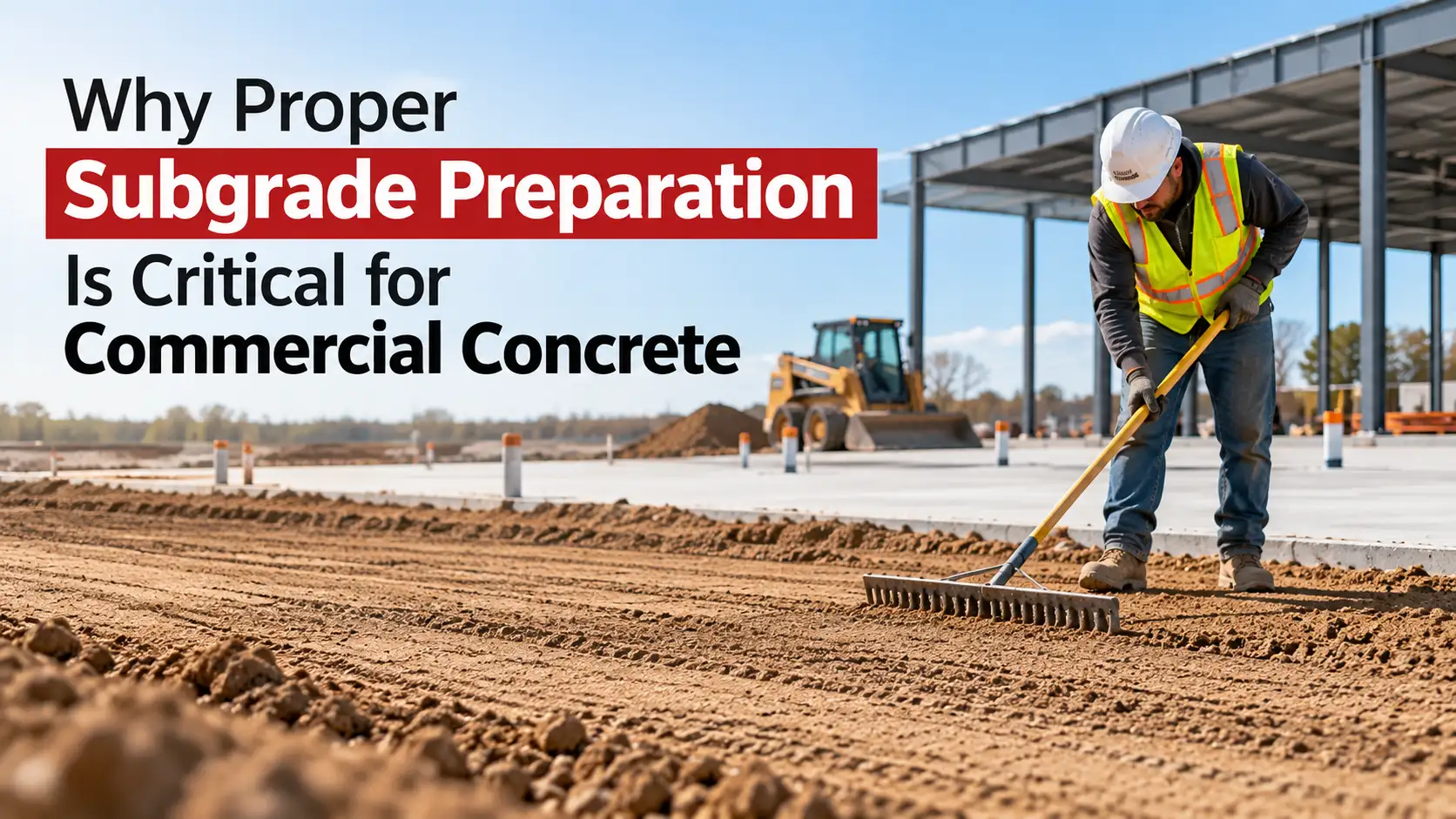
Subgrade preparation for concrete involves evaluating, conditioning, and compacting the soil before concrete placement. Poor preparation can lead to uneven settlement, cracking, and costly repairs. In Northeast Florida, where rainfall can change soil moisture conditions, preparing the ground properly is especially important for dependable slab performance.
What Is Concrete Subgrade Preparation?
The subgrade is the natural soil or prepared fill directly beneath a concrete slab’s base layer or, in some designs, beneath the slab itself. It provides the underlying support that helps distribute loads into the ground.
The subgrade is different from the subbase. The subgrade is the prepared soil, while the subbase is an additional layer, often made from compacted aggregate, installed above it when the design calls for one.
Both layers have distinct purposes. A properly prepared subgrade helps provide consistent support, while a suitable aggregate base can improve load distribution and provide a more uniform working surface.
Why Uniform Soil Support Matters
Concrete can carry substantial loads, but its performance depends partly on how evenly the ground supports it. If one section of the subgrade is firm while another is soft, the slab may experience differential movement as loads are applied or soil conditions change.
This can contribute to cracking, uneven surfaces, joint problems, and damage around equipment or building components.
Uniform support is especially important for commercial projects involving forklifts, delivery vehicles, storage racks, and other concentrated loads. When evaluating commercial load capacity, contractors and designers must consider the slab thickness, reinforcement, concrete properties, joint layout, and supporting soil together.
How Soil Conditions Affect the Preparation Process
Not every construction site has the same soil conditions. The right preparation approach varies with soil type, moisture levels, drainage conditions, and the loads the finished slab will support.
Florida’s geological conditions include sandy soils, organic deposits, and areas with expansive clay. The Florida Department of Environmental Protection notes that expansive clay can shrink or swell as moisture changes, while organic soils may lose volume and contribute to settlement.
For commercial projects, soil evaluation helps identify conditions that could affect foundation stability.
| Soil or site condition | Potential concern | Possible response |
| Loose or poorly compacted soil | Settlement under loads | Compact suitable material |
| Organic soil | Decomposition and volume loss | Remove and replace where specified |
| Expansive clay | Shrinkage or swelling | Follow geotechnical recommendations |
| Excessively wet soil | Difficulty achieving compaction | Condition or replace unsuitable material |
| Poor drainage | Water accumulation and weakening | Correct drainage where required |
A geotechnical professional can recommend testing or treatment when the existing ground does not provide suitable support.
The Essential Steps Before Concrete Placement
Preparing subgrade for a concrete slab requires more than leveling the surface. Each step helps establish the conditions needed for the next stage.
Inspect the soil and remove weak material
Begin by reviewing the site conditions and confirming the required subgrade elevation. Remove vegetation, roots, organic matter, debris, and unsuitable soil as directed by the project specifications.
If excavation exposes soft spots or unexpected soil conditions, these areas should be assessed before proceeding. Covering weak material with aggregate without correcting the underlying problem may not provide reliable support.
Balance Soil Moisture Before Compaction
Soil must have a suitable moisture content to achieve the specified density. Material that is too dry may resist compaction, while excessively wet soil can become unstable or fail to reach the required density.
Contractors use suitable compactors based on the soil type, working area, and project requirements. Moisture conditioning may involve adding water or allowing soil to dry before compaction.
Proof-roll the prepared surface
Proof rolling uses suitable heavy equipment to identify areas that deform, rut, or deflect under load. It helps reveal unstable sections that may not be obvious during a visual inspection.
Proof rolling does not replace required density testing. If soft spots appear, the contractor should correct them and repeat the appropriate checks before concrete placement.
When Is Soil Stabilization or an Aggregate Base Needed?
Certain sites require extra preparation to provide adequate support. Depending on the soil investigation and design, options may include replacing unsuitable material, blending aggregate, using geotextile fabric, or applying an engineered stabilization method.
An aggregate base may provide a more uniform platform and assist with construction drainage. However, adding a thicker gravel layer does not automatically solve deep weak-soil problems.
The correct approach depends on the cause of the instability. Material choices, layer depths, and stabilization techniques should align with the geotechnical findings and project requirements.
Northeast Florida Weather Makes Moisture Control Important
Rainfall can change soil moisture and affect when compaction work can proceed. Jacksonville’s 1991–2020 climate normals record approximately 53.40 inches of precipitation annually, illustrating the amount of moisture construction teams may need to manage in Northeast Florida.
This regional figure is a long-term climate average, not a prediction for an individual project. Actual site conditions can vary with season, drainage, soil composition, and recent weather.
Before a slab is poured, contractors should check for standing water, pumping soil, erosion, and areas disturbed by rain. If the surface becomes saturated or unstable, the affected material may need to dry, be reworked, or be replaced before work continues.
Verify Compaction Before Pouring Concrete
A surface that looks level is not necessarily ready for concrete. Quality control confirms that the prepared subgrade meets the project’s specified requirements.
Important checks may include:
- Density testing: Confirms whether soil compaction meets the specified target.
- Moisture testing: Helps determine whether soil conditions are suitable for compaction.
- Elevation checks: Verify the prepared surface against design elevations.
- Proof-roll observations: Identify areas that deform under suitable equipment.
- Corrective work records: Document how unsuitable areas were addressed.
There is no single compaction percentage or aggregate thickness that applies to every commercial slab. The required values should come from the project plans, geotechnical report, and applicable specifications.
Concrete Advantage can help commercial projects with proper subgrade preparation and coordinate concrete work around the project’s support and placement requirements.
Frequently Asked Questions
Does every commercial concrete slab need an aggregate base?
No. The need for an aggregate base depends on the design, soil conditions, drainage requirements, and project specifications. Some slabs require a separate base layer, while others use a different approved support system.
Can concrete be poured over wet soil?
Only when the prepared conditions meet the project’s requirements. Excessively wet or unstable soil can prevent proper compaction and compromise support. The contractor should assess the condition and correct any problems before placement.
How is proper subgrade compaction verified?
Depending on the specifications, verification may include field density tests, moisture measurements, proof rolling, and elevation checks. The required testing method and acceptance criteria should be established before construction.
Final Thoughts: Build a Stable Base for Long-Term Performance
Proper subgrade preparation helps commercial concrete slabs manage loads and reduces the risk of uneven settlement. Soil evaluation, moisture control, compaction, stabilization, and verification all contribute to a more dependable foundation for the concrete.
Concrete Advantage understands the importance of preparing the supporting surface before placement. Following the project specifications and addressing weak areas early helps protect the slab’s performance and reduce the risk of avoidable repairs.