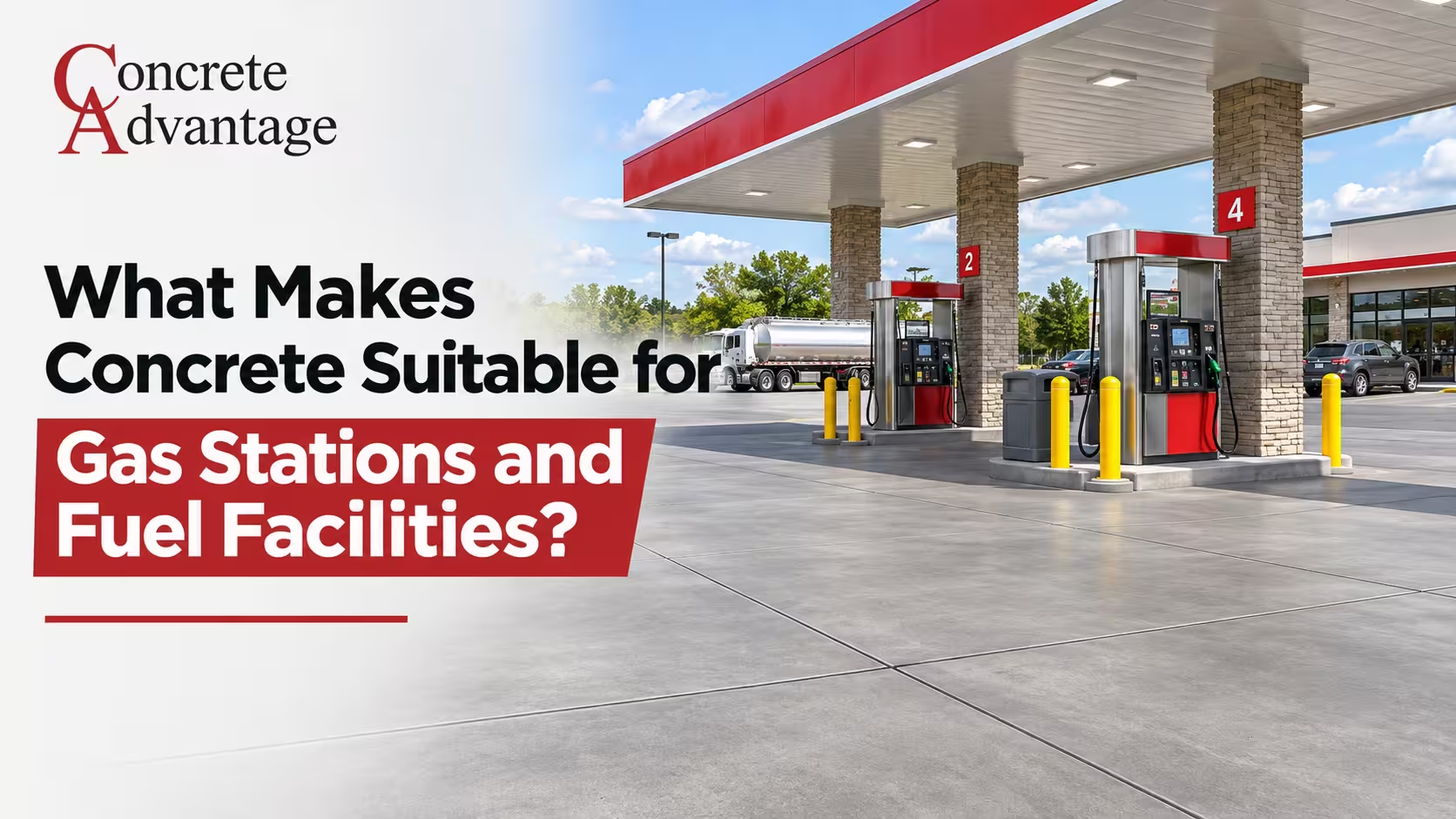
A fuel tanker pulls into a Jacksonville gas station to refill underground storage tanks while customers continue using the pumps. Cars turn sharply around dispenser islands, trucks cross the entrance, and rainwater moves across the pavement. Meanwhile, small gasoline drips and oil residue collect in areas that see traffic all day.
If the concrete was not designed for these conditions, cracking, surface deterioration, drainage problems, and costly repairs can develop much sooner than expected. Gas station concrete requirements go beyond a strong mix. Pavement must handle loads, wear, petroleum exposure, drainage, and spill controls, with design details matched to each area.
Heavy Traffic Requires More Than a Basic Parking Slab
Gas stations serve passenger vehicles, but delivery areas may accommodate fuel tankers, commercial trucks, and emergency vehicles. Their axle loads and turning movements can crack, damage joints, or settle an undersized or poorly supported slab.
Portland cement concrete can provide a durable fueling-lane surface. An engineer should select thickness, strength, reinforcement, joints, and subgrade preparation for expected loading instead of applying one standard design everywhere.
Concrete design considerations include:
- Expected vehicle types, axle loads, and turning points.
- Stable, compacted subgrade and suitable base materials.
- Slab thickness and concrete strength matched to use.
- Joint placement to manage movement and reduce random cracking.
Truck lanes may need heavier-duty pavement than customer parking or sidewalks. Matching design to each zone helps avoid overbuilding some areas and underbuilding the hardest-working ones.
Common design mismatches to avoid:
- Specifying the same slab thickness for the entire property without reviewing delivery routes.
- Placing joints where truck wheels repeatedly turn or stop.
- Pouring around equipment without coordinating anchor bolts and service conduits.
- Opening a lane before concrete reaches the specified strength.
These decisions affect not only the slab but also maintenance access and station downtime. Early review is often easier than cutting, patching, or closing an active fueling lane later.
Concrete Around Fuel Dispensers Has Different Risks
Pump islands experience stopping, turning, and fuel drips. Gasoline, diesel, and oil can penetrate concrete pores, cracks, joints, or poorly sealed penetrations, especially when spills remain uncleaned.
Island foundations must support equipment, and surrounding pavement should allow vehicles to maneuver without creating collection points. Coordinate bases, conduits, piping, and sleeves before pouring to avoid cutting finished slabs later.
Where Concrete and Surface Protection Matter Most
Different facility zones face different conditions and may need different finishes or protection.
| Facility area | Main concrete concern | Planning focus |
| Fuel dispenser islands | Spills, equipment loads, tight turns | Island foundations, joint details, compatible protection |
| Fuel tanker delivery zone | Heavy axle loads and hose handling | Pavement design, access, spill controls |
| Customer parking and store entrance | Vehicle wear and pedestrian movement | Durable finish, accessible routes, traction |
| Service or maintenance area | Oil, cleaners, abrasion | Exposure review, cleanup, protective system |
| Drainage and collection zones | Water and contaminated runoff | Slope, inlets, containment coordination |
Fuel Resistance May Require a Coating or Other System
Concrete is porous. Compatible chemical-resistant coatings may reduce absorption and ease cleaning, but products differ: resistance to one chemical does not guarantee resistance to another or repeated exposure.
Before selecting a protective system, the project team should check:
- Compatibility with gasoline, diesel, oil, and site chemicals.
- Resistance to abrasion from tires, turning vehicles, and cleaning.
- Surface preparation, moisture limits, curing time, and application conditions.
- Whether protection is intended for occasional drips or frequent chemical exposure.
Coatings cannot repair moving cracks or failed joints. The substrate must be sound, and maintenance requirements should be clear.
Drainage and Spill Containment Must Be Coordinated
Fuel stations need slopes and drains that prevent pooling around dispensers, slippery walkways, or fuel-contaminated runoff reaching storm drains.
Jacksonville averages about 53.4 inches of precipitation annually based on 1991–2020 climate normals. Rainfall is notably higher during summer, with June averaging 7.60 inches and September 7.56 inches at Jacksonville International Airport. These local conditions make grading and inlet placement important to prevent ponding and uncontrolled runoff.
Containment may include curbing, sealed surfaces, dedicated drainage, and collection equipment, not simply thicker concrete. Tanks, piping, dispenser sumps, and spill controls must meet applicable Florida DEP and EPA requirements for the specific installation.
Joints, Weather, and Maintenance Affect Service Life
Joints allow movement and help control cracking. Coordinate them with traffic, islands, drains, and equipment. Sealants need to tolerate expected movement and chemical exposure.
Jacksonville’s wet summer makes placement and curing important. Rain can affect finishing, and early traffic can damage concrete before it gains strength. Protect fresh slabs and follow opening requirements.
Facility managers should inspect for:
- Cracks that are widening or allowing liquid to penetrate.
- Failed joint sealant, chipped edges, or surface scaling.
- Low spots that hold rainwater, fuel, or oil residue.
- Worn, peeling, or blistered protective coatings.
- Settlement near islands, drains, or utility trenches.
Prompt cleanup and repair limit deterioration. Follow curing and reopening restrictions for coatings or resurfacing.
Construction Planning Keeps Fuel Facilities Safer
Concrete work can disrupt customers and deliveries. Coordinate closures, detours, emergency access, underground utilities, tank and piping protection, and placement sequence before work starts.
A preconstruction checklist helps catch details before the pour:
- Confirm traffic loads, slab details, base conditions, and joint layout.
- Coordinate dispenser foundations, conduits, piping, and tank-related components.
- Review slope, drainage, spill containment, and runoff plans.
- Confirm coating or protection requirements and compatibility.
- Plan curing, inspection, barricades, and safe reopening.
Concrete Advantage helps property owners and project teams plan concrete construction for fuel facility conditions. Designs and protection should match traffic, exposure, and applicable standards.
Frequently Asked Questions
Is concrete naturally resistant to gasoline and diesel?
Concrete is durable but porous, so petroleum can enter cracks, joints, or the surface. Protection and prompt cleanup may be needed.
Does every gas station need a coating?
Not every area needs coating. Exposure, maintenance, and product compatibility guide the decision.
What concrete is best for fuel dispenser areas?
Slab design depends on vehicle loads, soil, exposure, and engineering requirements. A qualified designer should specify it.
Why is drainage important at fuel stations?
Drainage limits ponding and slip hazards. Fuel-contaminated runoff needs an approved collection or treatment route, not a storm drain.
How can gas station concrete last longer?
Proper subgrade, slab design, joints, compatible protection, spill cleanup, and inspections support service life.
Final Thoughts: Concrete Built for Fuel Facility Demands
Gas station slabs face traffic, fuel, weather, and cleaning. Concrete design, subgrade, joints, drainage, coatings, and spill controls should work together and follow applicable standards.
Concrete Advantage works with property owners and project teams on concrete construction for demanding sites. Properly specified, maintained pavement can limit premature deterioration and support reliable operations.