
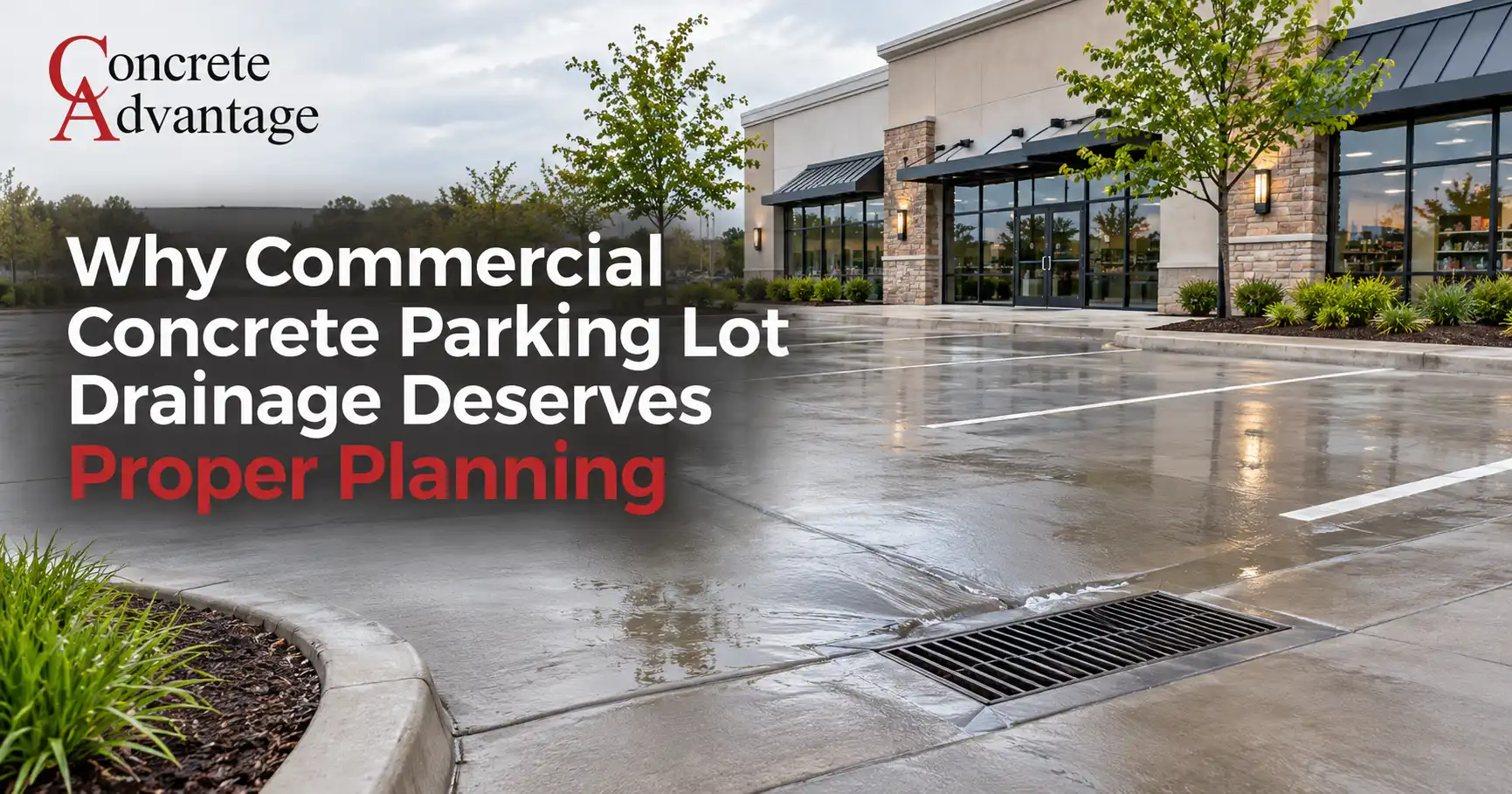
A commercial concrete parking lot must move rainwater away from parking spaces, walkways, entrances, and pavement edges. Without a clear drainage plan, standing water creates safety concerns and exposes concrete and its supporting base to avoidable damage.
Jacksonville’s seasonal rainfall makes this planning especially important. A sound layout combines pavement grading, collection points, and suitable discharge routes. It is easier to address these details before placement than to correct low spots after the lot opens.
What Poor Drainage Can Do to a Commercial Parking Lot
Standing water can create slippery areas, conceal cracks, and make accessible routes difficult to use. Repeated runoff at joints or pavement edges may also carry soil away or enter existing weaknesses, affecting safety and increasing maintenance needs.
Poor drainage may contribute to:
- Surface deterioration: Water entering cracks and joints can worsen existing defects under repeated vehicle traffic.
- Base problems: Persistent moisture can soften inadequately drained supporting materials and contribute to settlement or uneven slabs.
- Edge erosion: Concentrated runoff can wash soil from landscaped borders, shoulders, and areas beside curbs.
- Building exposure: Runoff directed toward entrances or foundations increases the risk of water intrusion.
- Access problems: Puddles near storefronts, loading zones, and walkways inconvenience customers, staff, and delivery drivers.
Good drainage limits avoidable water exposure.
How Concrete Grading Directs Water
Concrete needs a planned slope that directs rain toward a curb, gutter, catch basin, drainage swale, or other approved feature. Flow direction matters as much as the finish.
Slope depends on site elevations, pavement use, accessibility, drainage capacity, and local standards. Before placement, confirm:
- Finished elevations: Set grades for parking stalls, drive aisles, sidewalks, entrances, and loading areas.
- Flow direction: Keep runoff away from buildings and neighboring properties.
- Low points: Identify where water may collect and provide a route to a drain or swale.
- Tie-ins: Coordinate new pavement with existing roads, curbs, sidewalks, and drainage structures.
A checked grading plan prevents inherited drainage problems.
Drainage Features That Help Manage Runoff
Stormwater features work together. Their selection depends on paved area, site elevations, soil, and the approved drainage plan; adding a drain alone is not enough.
| Feature | Purpose | Maintenance concern |
| Catch basin | Collects runoff at a low point | Keep grates and sediment sumps clear |
| Curb and gutter | Guides water along pavement edges | Watch for blockage and incorrect grade |
| Drainage swale | Carries runoff through a vegetated area | Prevents erosion and maintains vegetation |
| Subbase drainage | Manages water within pavement support layers | Confirm the outlet and design |
Install catch basins in low-lying areas and connect them to a proper drainage outlet. Poor placement can leave puddles nearby, while unstable swales may erode under concentrated flow.
Why Jacksonville’s Rainfall Makes Planning Important
The Florida Climate Center reports 53.40 inches of annual precipitation at Jacksonville International Airport under the 1991–2020 climate normals. June through September each average between 6.77 and 7.60 inches. Together, those four months account for approximately 28.81 inches, more than half of the annual normal.
These averages are not storm predictions, but they show why sites need capacity for seasonal rainfall. Jacksonville’s Land Development Procedures Manual also requires proposed discharge to be evaluated against downstream drainage capacity. A project should not transfer runoff problems to neighboring properties.
Florida stormwater permits may also apply to development or redevelopment. The Department of Environmental Protection says Environmental Resource Permits address stormwater quantity and quality. Confirm city and water management district requirements before changing drainage features.
Signs Your Parking Lot May Have a Drainage Problem
Inspect the lot after rainfall. Identify areas where water collects and check whether it spreads toward structures or pedestrian paths. Recurring ponding may indicate poor grading, a blocked inlet, or settlement that changed the pavement slope.
Look for:
- Puddles that remain after nearby pavement drains.
- Runoff flowing toward entrances, foundations, or neighboring lots.
- Soil washout beside curbs, pavement edges, or swales.
- Catch basins that overflow, clog repeatedly, or sit above low spots.
- Cracks, separated joints, or uneven slabs near recurring ponding.
A single puddle may be a low spot; widespread pooling can signal a larger capacity issue. Identify the cause first.
When Drainage Work Should Accompany Concrete Repairs
Repairing a crack or settled slab without correcting drainage may leave the cause untouched. Check the grade, base, joints, and outlet before selecting a repair.
Minor problems may need inlet cleaning or swale repairs. Larger issues can require regrading, moving collection points, repairing connections, or rebuilding a damaged subbase. Changes to grading or discharge may need engineering and regulatory review.
Concrete Advantage helps commercial property owners consider drainage conditions when planning concrete repairs or replacement, rather than treating water management as an afterthought.
Frequently Asked Questions
Why does water pool on a concrete parking lot?
Pooling usually means the surface has a low spot, the pavement slope does not direct water effectively, or a drain is blocked or poorly positioned. Settlement can also change the original grade. The repair depends on whether the problem is limited to the surface or involves the supporting base.
Does concrete need a slope for drainage?
Yes. Planned grades move rainwater toward suitable collection points instead of allowing it to remain on the surface. The appropriate slope depends on site design, accessibility, pavement layout, and applicable standards. It should be established in the project plans rather than guessed during placement.
Can poor drainage damage concrete pavement?
It can contribute to deterioration when water enters cracks and joints or weakens supporting materials. Repeated moisture exposure may worsen settlement, erosion, and existing defects. Drainage is one part of pavement durability, along with base preparation, concrete placement, joints, and maintenance.
Are catch basins enough to solve parking lot drainage?
No. Pavement must direct runoff toward the basin, and the connected system needs a suitable outlet and enough capacity. Poor placement, clogged grates, or downstream restrictions can still leave standing water even when catch basins are present.
When should a commercial property owner request a drainage assessment?
Arrange an assessment when ponding keeps returning, runoff reaches buildings, soil washes away near pavement, or slabs settle around wet areas. It is especially useful before concrete replacement, because correcting the water route during the project may help prevent the same problem from recurring.
Final Thoughts: Make Water Management Part of the Pavement Plan
Commercial concrete drainage protects more than the surface. Proper grading and functioning collection features help reduce standing water, erosion, access problems, and avoidable deterioration. Jacksonville’s seasonal rainfall makes runoff planning especially important before construction. Concrete Advantage can help assess concrete conditions and provide repairs needed for a better-performing parking area.