
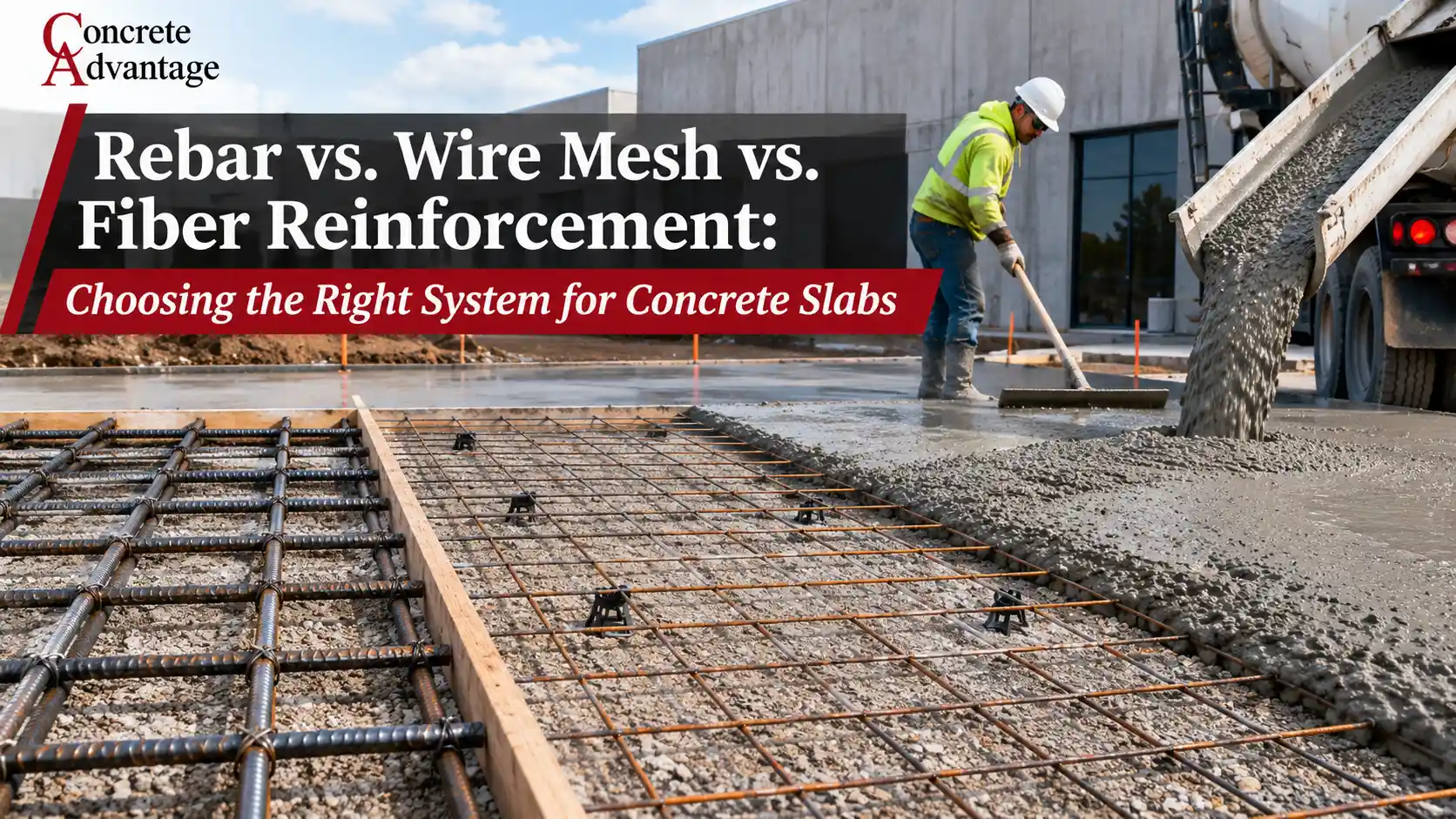
Concrete is strong under compression, but it is less capable of resisting tension. As a slab experiences shrinkage, temperature changes, equipment movement, and repeated traffic, cracks can develop. Reinforcement helps manage these stresses and improve performance, but not every system works the same way.
For commercial projects in Jacksonville, FL, choosing between steel rebar, welded wire reinforcement, and concrete fibers means looking beyond initial cost. The slab’s intended use, design requirements, and installation conditions all matter. Understanding these differences helps property owners and contractors select reinforcement that suits the project.
Why Does Concrete Slab Reinforcement Matter?
Reinforcement helps control cracking and, when properly designed, contributes to a slab’s ability to resist structural forces. However, it does not make concrete crack-proof. Instead, it helps manage crack development, maintain the intended performance of the slab, and support durability under expected conditions.
The purpose also depends on the application. A warehouse floor carrying forklifts has different demands from a pedestrian walkway or a small equipment pad. Reinforcement selection should therefore follow the engineered specifications rather than a general preference for one material.
1. Steel Rebar: A Strong Option for Demanding Applications
Steel reinforcing bars are arranged in a planned grid or pattern and secured before concrete placement. Their size, spacing, location, and concrete cover are determined by the design. Rebar can provide tensile capacity and help control crack widths when incorporated into an appropriate reinforcement layout.
Where rebar is commonly considered:
- Warehouse floors exposed to heavy equipment and concentrated loads.
- Commercial parking areas subject to repeated vehicle traffic.
- Equipment pads supporting substantial machinery.
- Slabs requiring specifically engineered structural reinforcement.
Rebar’s main advantage is its ability to provide substantial, predictable reinforcement when properly specified. It can also be combined with fibers to address different performance needs.
However, steel bars require accurate placement, adequate support, proper laps, and sufficient concrete cover. Poor positioning can reduce their effectiveness. In environments where moisture and chlorides create corrosion concerns, the specified steel protection and concrete cover also deserve attention.
2. Welded Wire Reinforcement: A Practical Grid for Crack Control
Welded wire reinforcement (WWR), commonly known as wire mesh, is made of steel wires joined by welds at evenly spaced intervals. The resulting grid is placed within the slab to help distribute reinforcement across its area.
It can be suitable for certain commercial floors, sidewalks, and other slabs where the engineered design calls for distributed reinforcement. Compared with individual rebar bars, mesh can be quicker to position across broad areas, particularly when supplied in suitable sheets or rolls.
| Advantage | Limitation |
| Consistent grid spacing | Must remain at the specified elevation |
| Distributed reinforcement | Lightweight mesh can move during placement |
| Useful for crack-width control | Not automatically suitable for heavy structural demands |
One frequent installation mistake is leaving mesh on the subgrade and pulling it upward while concrete is being poured. This does not reliably position the reinforcement. ACI guidance calls for welded wire reinforcement to be supported before placement, in accordance with the contract documents.
3. Fiber Reinforcement: Distributed Support Throughout the Mix
Fiber-reinforced concrete contains small fibers mixed throughout the concrete rather than arranged in a visible grid. These fibers help bridge developing cracks and can improve toughness, impact resistance, and post-cracking behavior. Their performance depends on the fiber material, shape, dosage, and intended application.
Two common categories serve different purposes:
Synthetic fibers: Microfibers are often used to help control plastic shrinkage and settlement cracking while concrete is still fresh. Synthetic macrofibers can provide additional post-cracking performance when properly specified.
Steel fibers: These are mixed into concrete to improve toughness and resistance to crack opening, impact, and repeated loading. Engineered steel-fiber systems are used in some industrial floors and other demanding slab applications.
Fiber reinforcement can offer more uniform distribution throughout the concrete and may simplify certain placement operations. However, it cannot automatically replace conventional reinforcement. A structural fiber design needs appropriate testing and engineering calculations to establish the contribution fibers can make.
How Do the Three Reinforcement Systems Compare?
| Factor | Rebar | Welded Wire Reinforcement | Fibers |
| Form | Steel bars | Welded steel grid | Dispersed fibers |
| Placement | Positioned and tied | Supported before pouring | Mixed into concrete |
| Main role | Engineered tensile reinforcement and crack control | Distributed reinforcement and crack control | Crack bridging and toughness |
| Common applications | Demanding commercial slabs | Suitable floors and flatwork | Floors, pavements, and other specified mixes |
| Main concern | Correct layout and concrete cover | Maintaining elevation | Correct fiber type and dosage |
There is no universal winner. Rebar offers a conventional solution where the design calls for continuous steel reinforcement. Wire mesh can suit slabs needing distributed reinforcement with a grid layout. Fibers provide a different approach, particularly for controlling early cracking and improving post-cracking behavior.
Which Reinforcement Works Best for Different Commercial Slabs?
The best choice depends on how the concrete will be used, not simply whether the project is commercial.
- Warehouse floors: Rebar, steel fibers, or a hybrid system may be considered where forklifts, storage racks, and repeated traffic create demanding conditions. The engineer must assess the design requirements.
- Parking lots: Rebar or welded wire reinforcement may be specified depending on the pavement design, joints, traffic, and site conditions. Fibers may supplement the selected system.
- Equipment pads: Concentrated loads, vibration, anchorage, and equipment requirements can make engineered rebar important. Fibers alone should not be assumed adequate.
- General commercial slabs: Wire reinforcement or fibers may be appropriate for certain applications, provided the specified system meets the project’s performance requirements.
Jacksonville, FL: What Local Requirements Should Contractors Consider?
Jacksonville projects must account for the applicable Florida Building Code and the requirements of the local authority having jurisdiction. The City of Jacksonville identifies the Florida Building Code, 8th Edition (2023), as its currently enforced code. Permit applications submitted from January 1, 2024, must reference that edition.
The code framework is important, but it does not prescribe one reinforcement system for every commercial slab. Project drawings, engineering specifications, applicable standards, and site conditions determine the appropriate solution.
Florida’s humid conditions and exposure to moisture also make durability worth considering. Reinforcement should have the specified concrete cover, and corrosion protection should be addressed where the exposure conditions require it. Contractors should verify the design and inspection requirements before placement rather than relying on a generic reinforcement schedule.
Installation Mistakes That Can Reduce Reinforcement Performance
Even a suitable material can underperform when installed incorrectly. Watch for these common problems:
- Incorrect positioning: Rebar and mesh must be held at the elevation shown in the plans.
- Insufficient support: Reinforcement can shift under workers’ feet or during concrete placement if chairs and supports are inadequate.
- Unapproved substitutions: Changing bar sizes, mesh specifications, or fiber dosage can affect the design.
- Poor coordination with joints: Reinforcement details must work with the planned contraction and construction joints.
- Inconsistent fiber mixing: Fibers must be distributed properly throughout the concrete to achieve the specified performance.
Before the pour, confirm that the reinforcement matches the approved drawings and that the placement team understands the required details.
Frequently Asked Questions
Can fiber reinforcement replace rebar in a commercial slab?
Sometimes, but only when the slab is specifically designed for a fiber-reinforced system. The engineer must verify that the selected fiber type and dosage provide the required performance. Fibers should not be treated as a direct replacement for specified structural steel.
Is wire mesh better than rebar for concrete floors?
Neither is automatically better. Wire mesh can provide distributed reinforcement for suitable slabs, while rebar offers a more substantial conventional steel layout for designs requiring it. The intended loads and engineering specifications should guide the decision.
Do concrete fibers prevent all cracking?
No. Fibers can help control certain cracks and improve post-cracking behavior, but they do not eliminate cracking. Proper mix design, curing, joint placement, subgrade preparation, and construction practices remain essential.
Final Thoughts: Matching Reinforcement to the Job
Rebar, welded wire reinforcement, and concrete fibers each serve useful purposes, but they are not interchangeable in every application. The right system depends on structural demands, crack-control goals, exposure conditions, and installation quality.
For commercial projects in Jacksonville, Concrete Advantage provides reliable concrete reinforcement solutions tailored to each project’s specific requirements. Starting with the engineered requirements helps ensure the selected system supports the slab’s intended performance.commercial projects